
Community Energy and Emissions Plan (CEEP) 2050
Project Update: October 2022
At their regular meeting on October 3, 2022, Council adopted the City’s new Community Energy and Emissions Plan. Thank you for your participation in the creation of this Plan, which will guide the City’s emission reduction action as we work towards eliminating net emissions by 2050.
Click here for the complete Plan, and here for the report to Council presenting the Plan and describing the feedback on the draft.
Scroll down, or click here, to read summaries of what we heard through previous community engagement, and how participants’ priorities are reflected in the Plan.
The City anticipates moving into implementing the Plan in the winter of 2022/2023.
Project Overview
Recognizing the importance of addressing climate change, New Westminster City Council adopted a Climate Emergency Declaration in 2019, committing the City to reducing greenhouse gas (GHG) emissions across the community to 45% by 2030, 65% by 2040, and 100% by 2050. In response to the climate emergency, the City established its Seven Bold Steps, which is guiding the process of moving the community towards a zero-carbon future by 2050.
The City is now developing its new Community Energy and Emissions Plan (CEEP) 2050 that will show the path for reducing energy consumption and GHG emissions throughout the community over the next 30 years.
The CEEP 2050 is intended to become the primary or overarching document for the community’s energy and emissions planning, and it will directly support the implementation of the Seven Bold Steps through the identification of energy and emission reduction opportunities, actions, and strategies. The plan will inform decision-making related to land use planning, waste management, sustainable transportation, and energy infrastructure and utility systems for the City.
Draft CEEP
The draft Community Energy and Emission Plan provides a roadmap to approach net zero by 2050, and is a call to action for the City and the broader community.
Jump to the sections described below that are most of interest to you, or review the complete CEEP here.
Part 1 – Defining the Challenge: includes an exploration of the climate challenge we are facing, and the particular impacts and emissions in New Westminster.
Part 2 – CEEP Actions: is organized into five key action areas, including targets for each area, and 55 specific implementation actions. The five action areas are:
- Transportation – supporting sustainable transportation such as biking, e-micromobility (e-bikes, etc.), and electric vehicles;
- Buildings – retrofitting existing buildings and requiring new buildings to be built to high energy efficiency standards that helps reduce emissions;
- Energy – supporting energy conservation, district energy, and renewable energy;
- Waste and circular economy – reducing waste and embracing circular economy principles, which involves reusing, sharing, repairing, refurbishing and recycling existing materials for as long as possible; and
- Natural areas and green infrastructure – preserving and enhancing natural areas and the urban tree canopy, and increasing the use of green infrastructure.
The biggest opportunities for GHG reduction are in the transportation and buildings sectors. Recommended actions in these areas look to ensure we reduce energy demand first, improve efficiency, and ultimately switch fuel sources to low carbon sources. This approach will help increase the resiliency of our electricity grid and make us better prepared to withstand the effects of climate change.
- Implementation of the CEEP will need to include flexibility, to ensure the City can adapt and pivot as new action opportunities arise with policy and technological change. Ensuring actions are implemented in an equitable way will also be critical to ensuring the transition to a low-carbon community benefits everyone.
Community Engagement
Thank you to everyone who participated and provided input throughout this process. The City conducted a variety of engagement activities from October 2021 to February 2022 to gather input on the CEEP development.
Your feedback and perspectives, combined with research and science, have helped shape a comprehensive, updated made-in-New West draft CEEP that will guide the City towards a low carbon, resilient, and equitable future. Click here to read more about the previous rounds of community engagement and key findings.
The City also gathered community input on the draft document, through July and August 2022, and is now finalizing the plan before bringing it to Council for consideration of adoption in fall 2022.
Please note: This project was launched on our previous public engagement platform. While all project information remains the same, the page layout and tools may look different and some older features may no longer be available.

Phases
What We Heard Summary for Round 2 Engagement
Project Update: August 19 2022
City staff promoted the draft CEEP and the opportunity to comment on it at pop-up engagement events in July and August 2022. Climate Action staff were part of a City booth at the New Westminster Farmers Market on July 21, where they let attendees know about the draft plan and gathered ideas for community action. Market-goers brought up a wide range of action areas, from building retrofits, to biking, e-biking and e-scootering, to reducing consumption of single-use plastics and packaging.
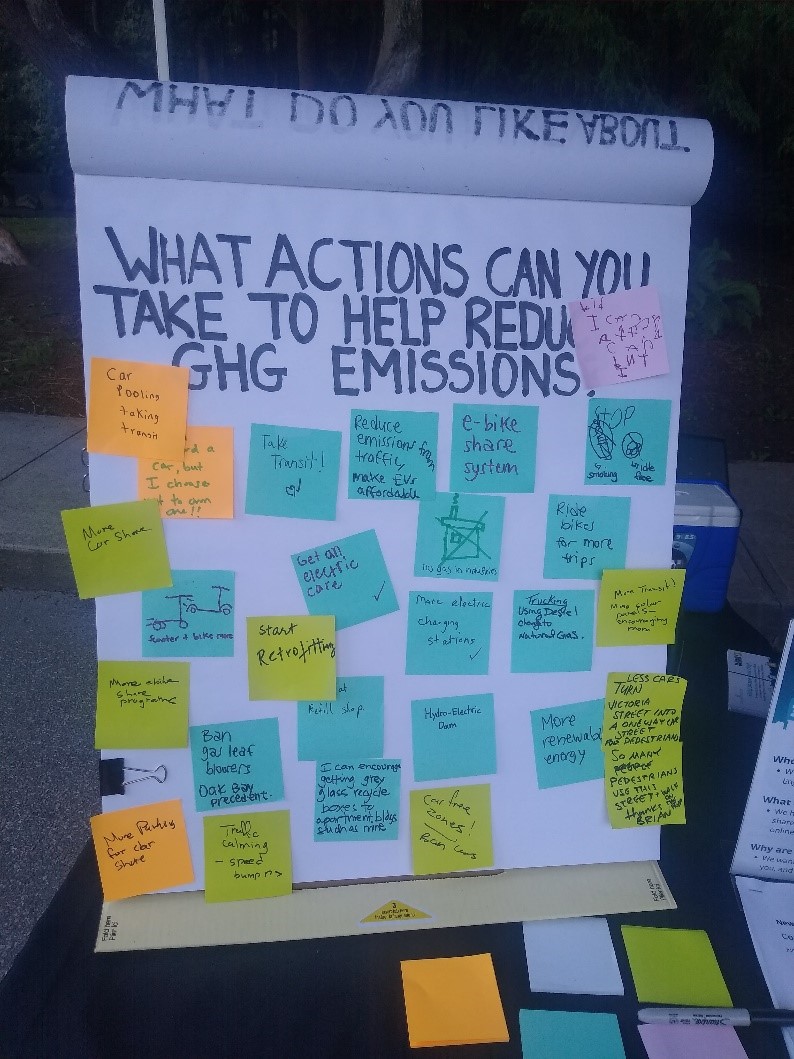
Pop-up engagement at the New West Farmers Market
The draft CEEP was posted on the Be Heard New West project page on July 14, and an online discussion forum and ideas board were open from July 14 to August 14. These opportunities to provide feedback on the draft were promoted through the Be Heard e-newsletter, social media, the City’s What’s Happening page, the CityPage e-newsletter, CityPage advertising in the Record newspaper, and an ad in the New West Anchor newsletter.
Engagement with Broader Community:
The discussion forum generated community dialogue, with 61 comments. Five residents posted on the ideas board. Two residents emailed the Climate Action team directly. Feedback conveyed a shared sense of urgency regarding climate action amongst participating residents. Discussion included the following:
- Support for rapidly completing an active transportation network that makes cycling and walking safer and more convenient, including by building out temporary improvements in the short term;
- Interest in building retrofits but concern about the cost to owners, as well as potential tenant displacement;
- Concern about through traffic, and related emissions and air quality impacts;
- Interest in more diverse land uses being permitted in neighbourhoods, including commercial uses and a wider range of missing middle housing;
- Support for significantly more tree planting on public lands, and increasing naturalized park areas;
- An interest in prohibiting new natural gas hookups immediately; many commenters were concerned about emissions and environmental impacts of gas branded as renewable natural gas, with one participant suggesting residents be provided fuel source choice.
Engagement with Key Interest Groups:
The draft plan was also circulated to industry representatives and other organizations who participated in workshops earlier on in the plan development. The following feedback was received:
- Fraser Health provided a letter supporting the direction of the draft plan, and suggesting ways to strengthen the health lens; and
- An energy-efficiency engineer provided extensive commentary on building retrofit opportunities, expressing support for the direction of the plan and the particular emphasis on retrofitting multi-unit residential buildings, which have not typically been the focus of rebates and incentives to date.